Best e-cigarette: how to actually decide
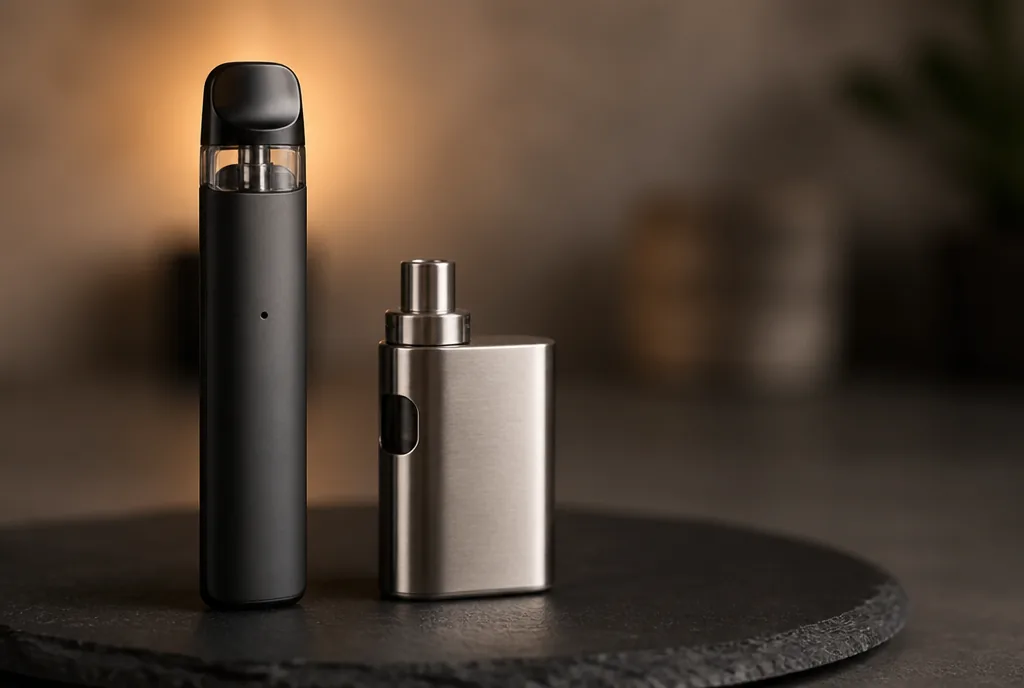
Every British site publishes its ranking, and no two agree. That is entirely logical, because the best e-cigarette does not exist in the abstract. It exists for a specific use. Rather than adding another league table to the pile, here is the decision grid we use internally: four knockout criteria and a blunt verdict by profile.
The best e-cigarette depends on how you use it
The right device is the one whose battery covers your day without a top up, whose coils you can find in your own town, and whose draw matches the habit you already have. Three conditions, in that order.
If a model fails any one of the three, no spec sheet will rescue it. That filter explains why a device praised everywhere can turn out to be quietly infuriating in your hands.
It also explains why British rankings age badly. With tanks capped at 2 ml and nicotine containing bottles capped at 20 mg/ml, the hardware differences that actually change your day are narrower than the marketing suggests, and they sit almost entirely in these four areas.
Best e-cigarette: four knockout criteria
A knockout criterion is not weighted against the others. You are not scoring candidates out of ten, you are removing the ones that cannot work for you. Put each contender through all four before you look at anything else.
The first is real battery life over one day. Milliamp hours do not convert directly into hours of use, because consumption follows power: the lower the coil, the faster the cell drops. The usable marker is simple, and it is binary. If you have to charge before the end of your day, the model is out, whatever its reputation.
The second is coil availability. An unobtainable coil turns excellent hardware into a paperweight within months. Check that the coil family is stocked by several British retailers, not only by the manufacturer, and favour coil ranges that have already survived two or three generations of devices. Those stay in catalogues long after a kit is discontinued.
The third is draw type. A tight, mouth to lung draw reproduces the sensation of pulling through a filter. An airy, direct lung draw needs a full open inhale and produces a great deal of vapour. A device engineered for one does not convert cleanly to the other, even with a higher resistance coil fitted, so pick the camp before the model.
The fourth is everyday robustness. Hardware lives in a pocket alongside keys. Reinforced shells and protected tanks survive drops far better than slim tubes, and this becomes the leading criterion the moment the device follows you onto a site or outdoors all day.
The verdict by profile
These are the calls we are willing to make, without diplomacy. They assume all four filters above have already been passed.
| Profile | What to aim for | What to avoid |
|---|---|---|
| Light, discreet use | Compact pod, coil above 1 ohm, 50/50 e-liquid | Powerful mod with multiple settings |
| Everyday all-rounder | Kit with a removable cell, adjustable draw, wide coil range | Model locked to a rare proprietary consumable |
| Heavy use, high vapour | Dual cell mod, coil under 0.5 ohm, larger tank | Closed pod with prefilled cartridges |
| Outdoor and travel use | Reinforced shell, stated water resistance, generous battery | Slim tube with no tank protection |
The compact pod wins comfortably for anyone chasing simplicity. The dual cell mod only justifies itself if you genuinely vape under 0.5 ohm for several hours a day, and that is a smaller group than the review sites imply.
What the rankings never measure
One thing slips past every top ten: the cost of consumables over twelve months. A cheap kit whose coil dies every five days works out dearer than a pricier model with a durable coil, and no ranking accounts for that.
Multiply the cost of one coil by the number of changes you expect in a year, then add it to the kit itself. The order of any league table usually rearranges completely once you do.
The second common omission is mundane and decisive: screen legibility in daylight, and whether the charging port is reachable without laying the device on its side. Neither appears on a spec sheet, and both are felt daily.
There is a third, specific to Britain. Because refillable tanks hold 2 ml, refill frequency becomes a genuine differentiator between two otherwise identical kits, and it is driven by the coil fitted rather than by the tank.
Testing a device in a shop in five minutes
A product page tells you nothing about real comfort. Five minutes with the hardware in your hand separates two candidates, and the test works without vaping at all.
Take the device switched off and drop it into the pocket you actually use every day. Walk a few steps. Weight and shape are judged there, not on a counter.
Then draw on it dry, mouthpiece fitted, to assess the resistance of the airflow. A draw that is too free or too tight registers immediately, and the airflow ring never fully corrects it afterwards.
Open the tank and go through the refill motion. The filling system should open one handed. Finally, look at where the charging port sits, since a port on the base means the device lies on its side to charge.
Those four gestures eliminate more bad choices than any specification comparison.
Stated power against usable power
One number dominates British product pages and carries almost no practical value: maximum wattage. It describes a capability, not a use.
Usable power is the range printed on the coils supplied. A device advertised at 100 watts, shipped with coils rated between 12 and 18 watts, will work in that band and nowhere else until you buy different coils.
Paying for headroom you will never touch means paying for extra weight and bulk. The only case where that reserve counts is a planned move to a low resistance build later on.
So read the range of coils available for the model rather than the figure printed large on the box. That range is what the device can genuinely do.
Classic buying traps
The same mistakes recur at every hardware change, and they are expensive.
- Buying maximum power instead of usable power.
- Trusting a stated puff count, which depends entirely on the draw.
- Ignoring weight, since past a certain point the device stays at home.
- Choosing a model released last month, before its coils are widely stocked.
- Forgetting to check which ratio suits the coils in the box.
That last point does real damage: a low resistance coil starved of liquid wears out in days. The bottle is part of the kit decision, not a separate one, so read how to match an e-liquid to your coil before you confirm the basket.
Frequently asked questions
Does a more expensive model always last longer?
Not mechanically. Lifespan rests on the quality of the contacts, the threading and the tank protection, none of which track the shelf figure reliably.
Built in battery or removable cell?
A removable cell extends the life of the hardware and lets you carry a charged spare. A built in battery wins on compactness and on charging simplicity.
Are complete bundles worth it?
Often yes, provided the bundle holds at least two coils and a bottle suited to them. A bundle with no spare coil loses most of its point.
How long should I keep the same device?
For as long as its coils are still stocked and the battery covers your day. Changing for the sake of it adds nothing once the four criteria are met.
Can I charge it from a phone charger?
A good quality charger at the right voltage is fine in most cases. Avoid very fast bricks not intended for this kind of device, which heat it needlessly.
What to check before you order
The best e-cigarette for you is identified in four questions: battery life, coil availability, draw, robustness. Once that filter is passed, the final call comes down to comfort in the hand and the real cost of coils, never to a position in a league table.
Reuse this grid at every hardware change, because it ages far better than an annual ranking does. If you want the same reasoning laid out as a decision tree, our guide on how to choose a vape walks through it question by question, and vaping for beginners covers the first week once the box is open.
Editorial content for adult readers only. Vaping products usually contain nicotine, a substance that causes addiction. Not for sale to under-18s in the United Kingdom. This article is not a buying recommendation.
Also on the site
Aspire PockeX: the guide to a good start
Aspire PockeX: what the Pocket AIO actually does, picking between the 0.6 and 1.2 ohm coil, the right bottle and a first fill without a burnt hit.
 02
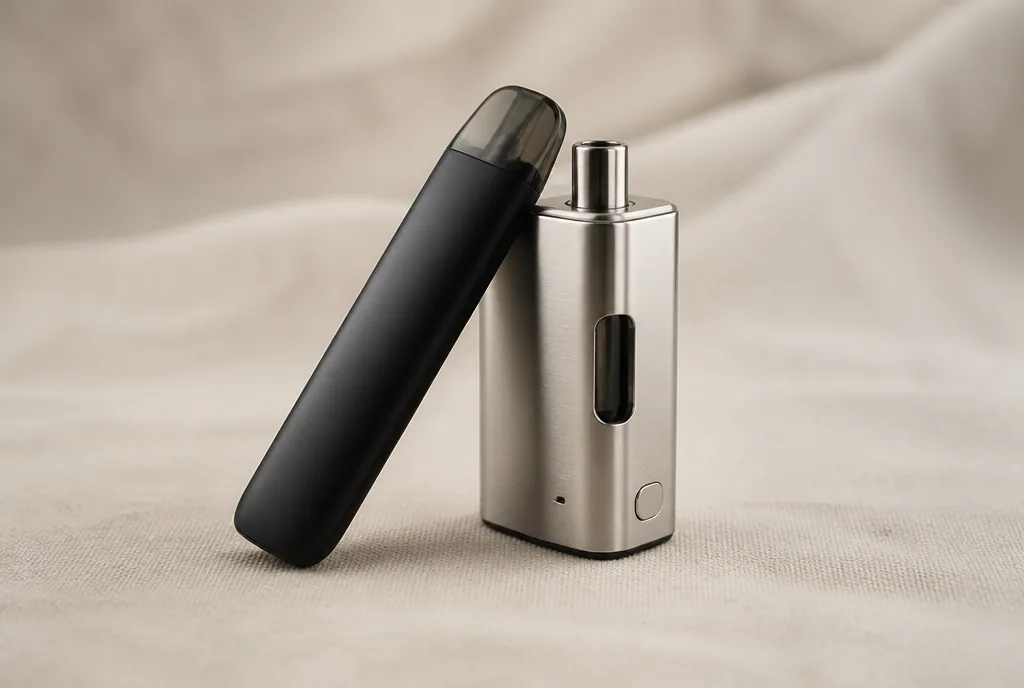
02 How to choose a vape: four questions is enough
How to choose a vape without losing an evening: a four question decision tree, a verdict for each answer, and the traps to dodge in the shop.
 03
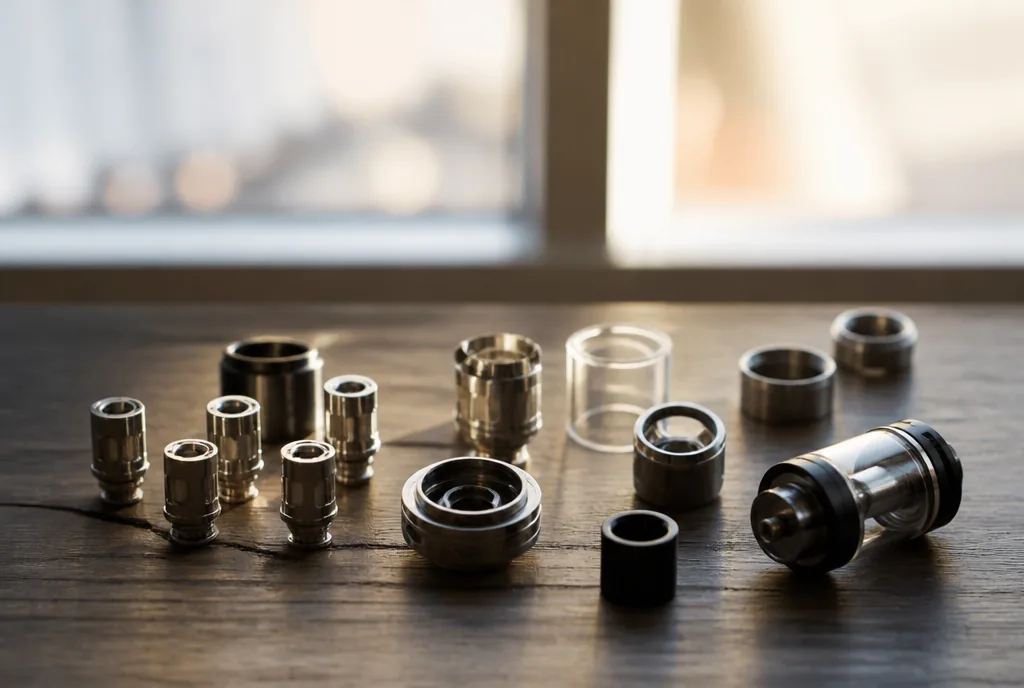
03 When to change your vape coil: the real signs
Forget the one to two week average: the four signals that say when to change your vape coil, and the method for measuring your own rhythm.